

Unite App | activism for youth
Empower youth to learn about, discuss, and participate in civic activism.
Project Type: UX/UI Mobile app design
Role: UX/UI Design, UX research alongside fellow group members.
Industry: Social Media, Activism
Tools: Figma, Notion, Illustrator, Zoom
Duration: 4 months
The Challenge
During the pandemic, youth participation in activism dropped sharply. With physical events cancelled and isolation growing, young people had fewer outlets to express opinions or feel heard.
Key pain points identified included:
-
A disconnect between youth and decision-makers.
-
Limited opportunities to contribute meaningfully without money or large time commitments.
-
Lack of safe online communities free from judgement.
-
Difficulty finding others with shared passions or causes.
How might we create a digital platform that makes youth advocacy safe, collaborative, and accessible to all?
Research
-
80% of youth were unaware of existing advocacy programs.
-
50% felt activism was easier online but less impactful.
-
66% reported worsened mental health during the pandemic.
-
All participants showed interest in learning more about advocacy and human rights.
These findings validated a major insight: youth needed a trusted, educational, and community-driven space to re-engage with activism safely.

We created the persona “Sarah”, a 14-year-old who recently moved to Waterloo and feels isolated by online schooling and social media noise.
Her story reflected a broader trend — young people wanted to contribute, but lacked guidance, safe spaces, and accessible entry points for real-world impact.
Design Ideas
From our insights, we defined clear goals:
-
Foster community and discussion to rebuild social connection.
-
Make learning engaging through multimedia content and interactive elements.
-
Enable creativity and participation through polls, annotations, and collaborative tools.
-
Ensure safety and privacy for youth under 18 through anonymous profiles and moderation.
-
Give youth a voice in shaping policy discussions with UNICEF and government organizations.
Design Process
We started with sketches and low-fidelity Figma wireframes, iterating together to visualize our solution.
The interface was designed around three main pillars: Learn, Discuss, and Act.


Final Solution
Login
-
Users can join as guests or sign up for added features.
-
Random usernames and customizable avatars maintain privacy and reduce bias.
Impact: Solved the issue of user hesitation and privacy concerns, making it easier for youth to join and engage confidently without fear of judgment or exposure.
Learn
-
Provides educational modules, videos, and articles curated by UNICEF.
-
Highlights trending topics like climate justice, mental health, and human rights.
Impact: This addressed the challenge of not knowing where to start with advocacy, turning curiosity into understanding and empowering users to engage with confidence.
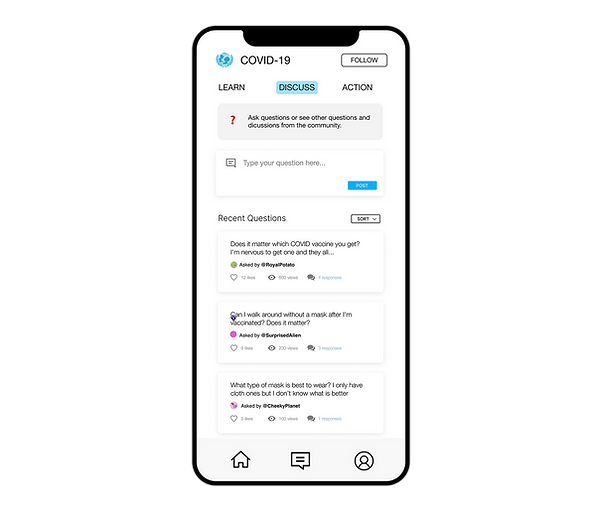
Discuss
-
A moderated space for youth to share thoughts, questions, and feedback.
-
Features highlighted messages from moderators and government officials to ensure credibility.
Impact: This directly solved the problem of online hostility and misinformation by creating a space that encouraged open, credible, and judgment-free conversations.
Action
-
The heart of the app — a kanban-style interface for planning and collaborating on advocacy projects.
-
Users participate in polls, contribute ideas, and annotate policy documents collaboratively.
-
Designed for real-world impact, with contributions reviewed for inclusion in UNICEF policy briefs
Impact: This bridged the gap between awareness and action, giving youth a structured way to apply what they’d learned and see their work contribute to tangible social change.



Next Steps
If expanded, future versions could include:
-
Direct mentorship features connecting youth to professionals.
-
Accessibility testing across different devices and screen readers.
-
Deeper integration with local advocacy campaigns and school.
Results
The UNITE App was awarded first place for its innovative approach to youth engagement in advocacy.
Impact Highlights:
-
Successfully bridged the gap between youth and policymakers.
-
Encouraged safe, anonymous participation while promoting collaboration.
-
Showcased how gamification and structure can make activism approachable for teens.
Key Takeaways
-
Empathy drives trust: Designing for safety made youth feel comfortable sharing ideas.
-
Structure encourages participation: Dividing the app into Learn, Discuss, and Act guided users intuitively.
-
Accessibility is engagement: Inclusive UX elements (anonymous login, clear visuals, low reading level) increased user confidence.